


History Truly Retold. This is what really happened, not the lies the colonial exploiters told.
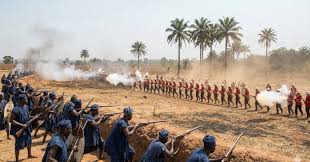
Ekumeku War: How Igbo Vigilantes Resisted Britain for 31 Years. Contrary to that British white washed and blandly false narrative about their colonial adventure into Africa, many powerful communities did not fold their hands and watch their colonial instruments like the British Royal Niger Company take over the country. Many of these extremely formidable traditionalsocieties like the IGBOs fought back, and this is the story of the 31-year Ekumeku Movement by a section of Igbos. An extremely powerful resistantce to colonial nonesense.
When the British Empire (through the Royal Niger Company) came to Nigeria and started gaining influence in 1807, they only had one mission, to gain control of all of Nigeria’s economic resources for the supposed power growth of the Crown government. They applied what Sociolgist who studied the British intrussion into Africa branded the three Bs. Bullets, Bible and Business.
And they did lay their hands, abeit temporary on these resources, through guile, falsehood and brutal uncivilized force. This brute force was applied across the protectorates and colony later known as Nigeria, by the use of then newly invented Maxin.
A Maxim is a machine gun (or submachine gun) developed by the American-British engineer Hiram Maxim (1840-1916). The energy released when firing a cartridge automatically loaded the next cartridge into the weapon. The cartridges were fed by means of woven fabric cartridge belts. It is called “the weapon most associated with the British Imperial Conquest”,[1] and was also used in colonial wars by other countries between 1886 and 1914.
Stories handed over by our grand fathers told stories of the dirtiest and filthiest arts of warfare used by these white men. Despite these desperate acts of atrocities, they lost totally.
The fact that we are still here and functioning powerfully, and they are gone, tells the final stories.
Despite all their attempts to twist the narrative to their advantage, they are the ones that reluctantly admitted that West Africa of that time was the White Mans Grave. This is because, they died in droves,, and evetually had to pact the retreat shamefully and permanently.
This is the story of how one tribal group resisted the British army, in a way they had never seen before.From the Rev. R.H. Stone’s memoir ‘‘In Afric’s Forest and Jungle, 1899.
The rarely documented struggle between the British and a united, underground Igbo resistance group called the Ekumeku lasted for 31 years.
The origins of the Ekumeku Movement
In the late 1880s, shortly after the Berlin Conference of 1884-1885 where European superpowers partitioned African countries The Royal Niger Company (RNC) a British firm trading in the Niger area, was expanding their domination from Lagos towards Western Igboland, which included the Niger Delta and Asaba.
While British traders were doing business with locals before the Conference, the power dynamics shifted even further in the coloniser’s favour after the Conference. Now, the Crown Government in continuation of the atrocities of the Slave crime (note that it was and still remains a crime, and not a commercial venture, as they tried to whitewash it as a trade) The traders were armed and assigned armed soldiers to enforce their dasdardly intentions.
They made all the laws, determined trading; with whom to trade, how much to trade, and lived as overlords in places where they were only welcomed through the force of their guns.
There were claims that “RNC exploited its monopoly far in excess of what it could have made in a free-trade situation, and spread terror, visiting the slightest whiff of local dissent with venom.
“In 1888, half of Asaba was decimated, and Obosi (a day’s walk away in what is now Anambra state) was razed to the ground the following year. In both cases the RNC alleged that the Asaba and Obosi people were involved in human sacrifice, hence the high-handed treatment.
“To ‘stop human sacrifice,’ the soldiers lived off the people’s livestock and food crops, and sexually assaulted the women. This led to a lot of resentment.”
Why was the Niger Delta special in the 1800s?
The British were attracted to the Niger Delta —then called the Oil Rivers Protectorate—because of its resource: palm oil. But why was it such an asset?
In the 19th century, Palm Oil was useful for many industrial processes. It was used as an industrial lubricant in tin-plate production, street-lighting, and as the fatty semi-solid for candle making and soap production. Palm oil made certain breakthroughs in soap chemistry and production possible.
Igbo men in the Oil Rivers area of present-day Nigeria bring calabashes full of palm oil to sell to a European buyer, c. 1900 [Jonathan Adagogo Green / The Trustees of the British Museum]
A palm oil factory likely in either Opobo or Bonny of Niger Delta, c. late 19th century [Jonathan Adagogo Green / The Trustees of the British Museum]
Now, let’s get back to the story
Despite their brash treatment of locals, the British were surprised to meet resistance from locals. These were located across the country and far into Igbo land in the east. But the ones that stunned the armed Brits were the Anioma people of present-day Delta State.
The Aniomas had gotten word of how the British established courts, introduced Christianity, and even selected local chiefs against the people’s will in other places. For the Aniomas, this was unacceptable. And they were not going down without a fight. So they went to war.
A British attack on Ndoni village in 1870 and Onicha-Ado in 1897 set the pace for the rest of the war as one of guns and bloodshed. The war would last in two waves: 1883-1902 when the locals first organised and fought back, and from 1904-1914.
The Ekumeku movement (meaning “don’t speak about it”) was comprised of the “otu okorobia”. These were young men from various Igbo villages and the nearby Niger Delta communities. They formed the Ekumeku secret organisation, the vigilante group which fought the British.
The name was given due to the stealth which the men used to fight. Unlike the British soldiers and mercenaries, who had great firepower, the locals were limited in the scope of weaponry. They instead devised guerrilla attacking styles: which took the Brits by surprise, leading to a series of defeats.
The power and victory of the Ekumeku
The strength of the movement simply lay in unity, skill and numbers. Before 1883, the Aniocha had a dispute with the Igbuzo clan, which had lasted for decades.
But seeing the power of British arms and ammunition, they decided that they could not fight the war individually. The tribes instead decided to make an alliance.
Other kingdoms such as Onicha-Ado (now present day Onitsha), also joined the movement.
However, Britain’s superiority in firearms would eventually come to play as the war protracted.
In December 1902, the British laid a preemptive strike which destroyed a large number of towns and imprisoned their leaders. As British officers were burning villages accused of taking part in the resistance, the resistance cooled off at this point. This was presumably to regroup.
The Second Rise of the Ekumeku
In 1904, the Ekumeku rose again. This changed tactics and concentrated in defending their towns instead of fighting together as they once did. This new strategy seriously stretched the already extremely weakeded colonial forces. this resulted therefore that in 1911, there was a plea from the Brish for a truce. This was because due to the rise of the Germans, war drums was stridently beating in their back yards. The brave Ekumeku did not see any reason to continue fighting these already defeated foes, and decided the lessen their aggression.
By 1914 when Nigeria’s Northern and Southern Protectorates and the Colony of Lagos were joined as one country. The badly beaten Britished were now fuly embroiled in a real extensial threat at home could obvoiusly not sustain this unending 31 year conlict. They swallowed their pride eat the awful tasting humble pie and conceeded defeat to the Ekumeku.
There are no official record on locals killed during the resistance, but it was one of the most devastating resistance to British occupation in Nigeria, leading to the death of a commander; H.C. Chapman.
The colonial government’s Collective Punishment Ordinance (CPO) – a law to punish an entire village suspected of entertaining the activities of the Ekumeku, was pivotal to ensuring the resistance did not return a third time.
The impact of the Ekumeku Movement
It served as an inspiration for other countries. Many historians believe that the Ekumeku Movement inspired the Kenyan Mau Mau Rebellion of 1952.
While it is not often spoken of, the Ekumeku Movement proves that the ancestors didn’t take their chains lying down
Of course, historians can easily connect this to the British instigated Biafra wars and the callous and black blooded British sponsoring of the most terible war crime that is recorded as BLOOD ON NIGER, on the children of the Ekumeku warriors who seriously humiliated them.
The utterances of Mr Harold Wilson and other politicians of Britain during the Biafra three years war support this asserssion.

