


Preserve your hostory for the next 2000 years
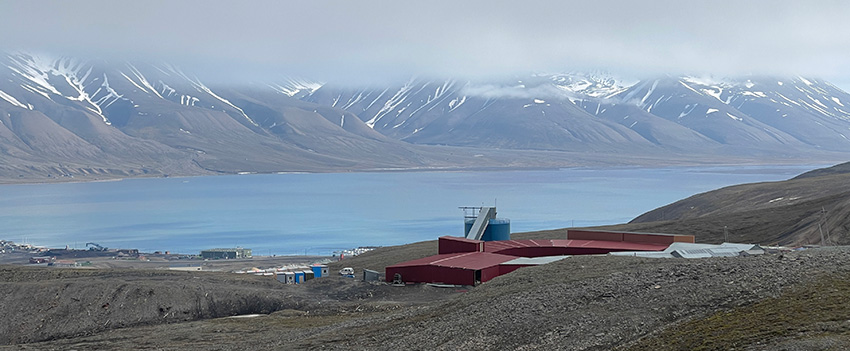
The vault in the decommissioned coalmine where data from around the world is stored. Photograph: courtesy of AWA
Gabriella Opara
It is the first African country to deposit data in the Arctic World Archive, a storage facility designed to preserve records of everything from cultural practices to historical event
A decommissioned coalmine near the north pole is the last place you’d expect to find Indigenous stories from rural Nigeria, but deep below the Arctic permafrost of Svalbard a storage unit contains a cache of cultural and literary records from the West African country.
The Arctic World Archive (AWA) is a data storage unit where organisations and individuals can deposit records kept on specialist digitised film called Piql that lasts up to 2,000 years. On 27 February, Nigeria became the first African country to place archives at the facility 300 metres beneath a mountain where the cold, dark, dry conditions are perfect for preservation.
Inspired by the nearby Svalbard global seed vault, a collection of more than a million seed samples stored as an insurance policy against catastrophe, AWA was established to hold the “world’s memory” for future generations. Started in 2017 by the Norwegian technology company that developed Piql, it contains an eclectic range of historical and creative records originating in 37 countries, from sources including the Vatican Library and the European Space Agency, and works as diverse as Chopin’s manuscripts and the work of Belgian photographer Christian Clauwers, who has documented the Pacific’s disappearing Marshall islands.
The view from the Arctic World Archive. Svalbard’s cold, dark, dry conditions are perfect for preservation. Photograph: courtesy of AWA
The Nigerian records are a mix of social and cultural history, and archives from its creative industries, drawn from 12 Nigerian organisations, including private art foundations, museums and libraries.
The collection was initiated by historian Nze Ed Emeka Keazor when he was appointed chair of Piql’s first Africa office in Lagos in 2022, and started to approach cultural organisations in Nigeria to encourage them to preserve their records.
“It took me a year and a half of going to Abeokuta in Ogun state to speak to the head of archives at the Olusegun Obasanjo Presidential Library,” says Keazor who travelled to Svalbard last month with colleague Esona Onuoha to hand over the archives.
Other institutions involved include Lagos art gallery Bloom Art; the Asaba Monument Trust which memorialises the 1967 Asaba massacre; Nsibidi Institute, a social research organisation run by Keazor; and the Umuchieze Community Legacy Deposit, a cultural project aimed at preserving Indigenous knowledge and history.
“It is important to me that Nigeria is remembered, because my work is about building cultural infrastructure,” says Ugoma Ebilah, founder of Bloom Art. “Nigeria has produced some of the world’s brightest and most creative people. It’s not a coincidence that in the same year this archive deposit is made, the Grammys finally decided to acknowledge the contributions of Fela Anikulapo Kuti [awarding him a Lifetime Achievement Award].”
During another significant moment for Nigeria’s creative community, British-Nigerian director Akinola Davies Jr won the outstanding debut Bafta for his film, My Father’s Shadow, a coming of age film that follows two brothers and their father during Nigeria’s historic 1993 election.
One of the key things that has affected Africa is memory … we have not been deliberate about protecting and projecting our narrative
Obi Asika, National Council for Arts and Culture
In his speech, Davies encouraged everyone to “archive your loved ones. Archive your stories, yesterday, today and for ever.”
In Nigeria, where libraries and museums are often underfunded and remain largely paper-based, it is easy for research or documents from the past to get lost or remain buried.
Aware of the fragility of public records, Dr Chima Korieh, an expert in West African social and economic history at Marquette University in Wisconsin, US, led a project to help Umuchieze community in Imo State, south-east Nigeria, preserve their stories, accounts of their cultural practices and rites to adulthood, and records from precolonial Nigeria. Its AWA deposits included manuscripts of the history of the Umuchieze people, and reports highlighting the community’s judicial and political systems.
“I can tell you, from 1960 onwards most of the public records that should be in the archives in Nigeria are not there,” says Korieh. “Some of the materials you have in the Nigerian archives today are in danger of being lost because they are not well preserved.”skip past newsletter promotion
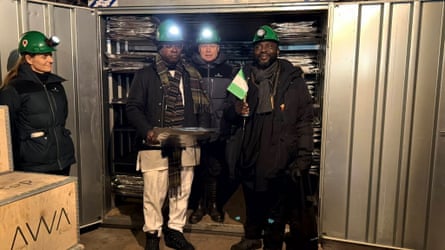
Nze Ed Emeka Keazor, second left, with AWA co-founder Katrine Loen, founder Rune Bjerkestrand (second right) and CEO of Piql West Africa Esona Onuoha making Nigeria’s deposit. Photograph: Courtesy of AWA
For Korieh the project is not just about storing information in a far-flung facility. “The whole community is involved in this process, and we aim to open up a community centre in Umuchieze where the public would have access to the materials.”
The National Commission for Monuments and Museums and the National Council for Arts and Culture also made deposits, including reports on Nigeria’s creative economy, such as the music and film industries.
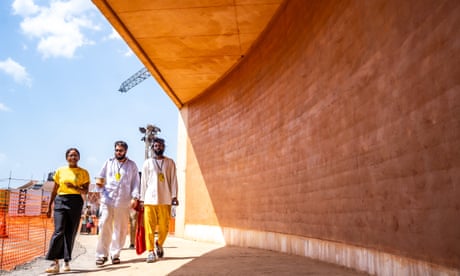
“One of the key things that has affected Africa is memory. It is oftentimes not properly recognised or stated because we have not been deliberate about protecting and projecting our narrative,” says Obi Asika, director-general of the National Council for Arts and Culture. “So when the opportunity came to partake and be part of the first in Africa to publish there, it was good to be part of history. We’re proud to be part of that.”
It is not just written history at risk of disappearing. According to a 2024 Pew Research Center study, 38% of webpages between 2013 and 2023 no longer exist, which means that a lot of information and history have simply disappeared. AWA grew out of a research project aimed at finding a secure way to store data longterm. “The world is getting more and more aware of how fragile data storage is – each time you need to migrate it, it can change,” says AWA co-founder Katrine Loen.
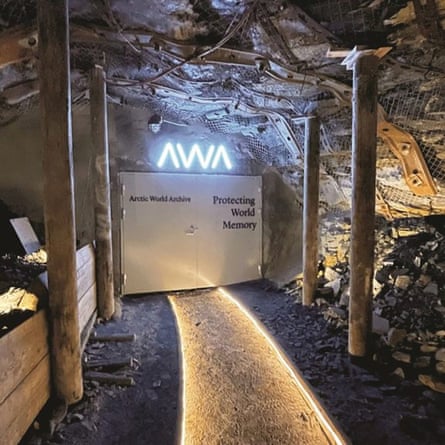
The archive grew out of a research project aimed at finding a secure and longterm way to store data. Photograph: Courtesy of AWA
But at €9,000 (£7,773) a reel, Piql film is an expensive investment for cash-strapped institutions. In response, AWA switched from being a commercial enterprise to a non-profit in 2025 so that funds can be used to subsidise organisations that need financial support to take part. This year it partnered with Unesco to archive the organisation’s memory of the world register, an archive of significant heritage documents, as well as records of world heritage sites, which will be stored as digital 3D scans.
Alongside the archives stored at AWA are instructions on how to decode them. It also intends to give depositers tokens that will tell future generations where to find the storage facility.
Svalbard’s unique geology, with rock formations from almost every geological era, has earned it a reputation for containing the history of the world. “Now,” says Loen “We are putting in the knowledge of humanity.”
For Nigeria, says Asika, it is the beginning of “a long journey towards narrative restitution and making sure that in all the spaces where we should be, we are presenting.”
- Iran threatens Gulf energy facilities after Israeli attack on its largest gasfield
- Israel strikes Iran’s South Pars gas field hours after forces kill intelligence minister
- LiveMiddle East crisis live: Israel strike on Iranian gas field reportedly coordinated with US; Tehran confirms intelligence minister killed
- Canadian man who hiked in woods in defiance of ban has case heard in court
- ‘Put him on trial’: pro-Kremlin loyalist turns on Putin in rare outburst
Related stories
 From Igbo to Angika: how to save the world’s 3,000 endangered languages7 Jan 2025
 Cutting-edge labs, a rainforest gallery and guesthouse: Nigeria to open art museum for 21st century18 Nov 2024
 Out of the ruins: film inspired by slum clearance in Nigeria opens in Toronto6 Sept 2024
- My embarrassing condition needs a simple operation – but in Nigeria few can afford it10 Jun 2024
 ‘In Nigeria, a tyre never quite dies’: reinventing the wheel in Lagos6 Jun 2024
 ‘Africa has zero PR in the west’: the Nigerian influencer using sarcasm on the clueless4 Jun 2024
 Noisy, performative and unapologetically non-European: Nigeria welcomes a museum like no other 30 Apr 2024
 ‘Embrace the unexpected’: African art boosts its presence at Venice Biennale26 Dec 2023
More from News
 Russia‘Put him on trial’: pro-Kremlin loyalist turns on Putin in rare outburst6h ago
 ExclusiveRevealed: a crypto billionaire’s political base hosting ‘anti-woke’ and rightwing activists in Westminster9h ago
 NorwayProsecutors seek more than seven years in jail for son of Norway’s crown princess5h ago
 UKGerry Adams tells high court he was stunned by 1996 Docklands bombing31m ago
 Live Barcelona v Newcastle: Champions League last-16 second leg8m ago
 Denmark A wealth tax for schools: Frederiksen’s shift left stirs debate before Denmark’s early election15h ago
 UK Farage called for release of Sean ‘Diddy’ Combs and praised effort to free drug trafficker4h ago
 Afghanistan Pakistan to pause Afghan strikes for Eid, two days after deadly Kabul attack3h ago
 ArchaeologyAncient skeleton unearthed in France is latest to be found sitting upright6h ago
Most viewed
Most viewed in Global development
A robust future? Why Brazil’s ‘bitter’ coffee is thriving as the climate crisis hits global crops.
A photo of Iran’s bombed schoolgirl graveyard went around the world. Was it real, or AI?‘The world’s memory’: why Nigeria is burying its history under a mountain in SvalbardMillions of children dying from preventable causes, report revealsDisappeared bodies, mass burials and ‘30,000 dead’: what is the truth of Iran’s death toll?‘A few beatings won’t kill you’: judge rejects divorce request of woman abused by husband in Afghanistan
AI-generated ‘poverty porn’ fake images being used by aid agencies
This article is more than 4 months old‘Invasive’ AI-led mass surveillance in Africa violating freedoms, warn experts‘Everyone feels like they are being scammed’: can Central America’s small coffee growers survive as global prices fall?
Original reporting and incisive analysis, direct from the Guardian every morning
- About us
- Help
- Complaints & corrections
- Contact us
- Tip us off
- SecureDrop
- Privacy policy
- Cookie policy
- Tax strategy
- Terms & conditions
- All topics
- All writers
- Newsletters
- Digital newspaper archive
- Bluesky
- Threads
- TikTok
- YouTube

