


Collins Nwke
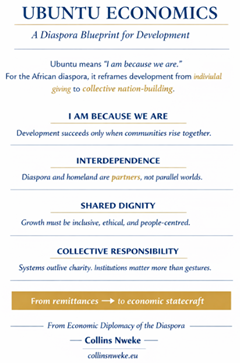
At COP30 in Brazil, African representatives in the People’s Assembly invoked the philosophy of Ubuntu: I am because we are. This is not as cultural nostalgia, but as a living economic philosophy. It is one capable of informing global development, climate action, and governance.
Financial software
This moment resonates deeply with the central argument advanced in my forthcoming book, Economic Diplomacy of the Diaspora: that Africa’s diaspora is no longer merely a remittance corridor, but an underutilised diplomatic and economic actor, capable of shaping development outcomes through values, networks, and strategy.
Ubuntu gives this proposition to its ethical spine.
Ubuntu as the Moral Architecture of Diaspora Economic Diplomacy
At its core, Economic Diplomacy of the Diaspora argues that diaspora engagement must evolve from transactional generosity to strategic systems-building. Ubuntu provides the philosophical logic for this shift.
Where conventional development thinking prioritises individual success, capital accumulation, and short-term outputs, Ubuntu insists on collective wellbeing, shared dignity, long-term resilience.
This aligns seamlessly with diaspora economic diplomacy, which operates at the intersection of capital, credibility, culture, and connectivity. These assets only deliver impact when mobilised collectively.
From Remittances to Economic Statecraft
One of the book’s central critiques is that diaspora remittances, while vital, are economically atomised. Ubuntu challenges diaspora organisations to reconceptualise remittances as proto-capital; the seed of collective economic statecraft.
In practical terms, this means pooling diaspora capital into community investment vehicles. It also means prioritising productive sectors over consumption and favouring patient capital over speculative returns.
In Ubuntu economics, wealth is not judged by how much leaves the community, but by how long it circulates within it. This transforms diaspora actors from benefactors into co-investors in national development.
Ubuntu and the Reframing of Brain Drain
A recurring theme in Economic Diplomacy of the Diaspora is the reframing of brain drain into brain circulation. Ubuntu strengthens this argument by redefining knowledge as a shared social good, not a private asset.
Diaspora professionals; in finance, medicine, technology, academia, diplomacy; represent reservoirs of social remittances. Ubuntu encourages their structured deployment through institutional partnerships, long-term mentorship pipelines, and policy advisory roles.
Here, diaspora diplomacy becomes less about heroic individuals and more about institutional capacity transfer. This is a key pillar of sustainable development.
Community-Centred Development as Diplomatic Practice
Ubuntu also reframes how diaspora groups design interventions.
In the book, I argue that effective diaspora diplomacy must be locally anchored and legitimacy driven. Ubuntu operationalizes this by insisting that communities are co-authors of development, not passive recipients.
A clinic without staff retention, a school without teacher pipelines, or an enterprise hub without market access is not diplomacy. It is symbolism. Ubuntu pushes diaspora initiatives toward ecosystem thinking, where projects reinforce one another and endure beyond donor cycles.
Ubuntu, Soft Power, and Diaspora Diplomacy
One of the book’s strongest assertions is that diaspora influence is a form of soft power. This is often more persuasive than official diplomacy. Ubuntu enhances this soft power by providing normative coherence.
When diaspora organisations advocate for inclusive growth, climate justice, ethical trade, humane migration policies, they do so not merely as lobbyists, but as custodians of a development philosophy now entering global discourse, including G20-adjacent debates and climate negotiations.
This elevates diaspora diplomacy from interest-based advocacy to values-based engagement.
Governance, Accountability, and Trust
Ubuntu is often mistaken for sentimentality. In reality, it is demanding.
Within Economic Diplomacy of the Diaspora, I stress that trust deficits are among Africa’s most costly development constraints. These are between states and citizens, institutions and communities. Ubuntu addresses this by insisting on transparency, accountability, ethical leadership, and restorative conflict resolution.
For diaspora organisations, Ubuntu is both a mirror and a mandate: credibility abroad depends on integrity at home and within diaspora structures themselves.
A Strategic Repositioning of the Diaspora
Ubuntu ultimately clarifies what diaspora economic diplomacy is not. It is not charity, either is it episodic intervention. It is also not perpetual opposition to home governments.
Instead, it positions the diaspora as co-architects of national resilience. It makes the diaspora brokers between global capital and local realities. They also become norm entrepreneurs exporting African ideas to global policy tables.
This is the essence of Economic Diplomacy of the Diaspora. The diaspora is not an appendix to national policy, but as an extension of it.
In the final analysis, we must position Ubuntu as the missing multiplier, one that does not reject markets or growth. It insists only that growth without community is incomplete, and diplomacy without values is hollow.
For African diaspora organisations seeking coherence, legitimacy, and lasting impact, Ubuntu provides the philosophical anchor that transforms goodwill into strategy and belonging into institution-building. As Africa’s diaspora navigates an era of fractured geopolitics, Ubuntu offers not just a moral compass, but a strategic advantage, one that can transform goodwill into lasting global impact.
Ubuntu explains why. And Economic Diplomacy of the Diaspora shows how.
Financial software

