


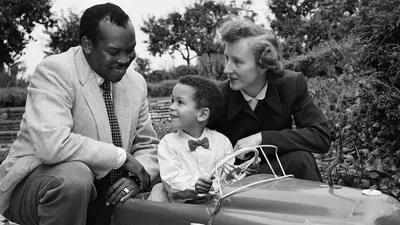
It all started with just a harmless dance in a church hall. The ripple effect of that innocent little dance no oe imagined would affect the government, peoples and history of three countries, and eventually cumulnate in the emergence of a fully indepent new country, with a new name, new government and of course a new president.
It was in London in 1947. A young man named Seretse Khama walked into a church hall social on an ordinary evening. He was a prince — heir to lead the Bamangwato people of Bechuanaland, a small territory in southern Africa. His future had been decided before he was born: finish law school, go home, become chief.
Then a woman named Ruth Williams walked through the door.
She was 24, a Lloyd’s of London clerk who had served in the Air Force during the war and come out the other side with quiet steel in her spine. Her sister had dragged her to the dance. She had nowhere particular to be.
Seretse asked her to dance. They talked until the hall emptied.
Within months, they both knew. This wasn’t infatuation. This was the kind of certainty people reorganize their entire lives around. They got engaged. They planned a future. And they were completely unprepared for what that decision would cost them.
They married on September 29, 1948, in a small registry office in London. No family on either side attended. Just a few friends, a quiet room, and two people who had chosen each other above everything else the world was offering.
Then the world responded.
South Africa had just built apartheid — a system that criminalized love between people of different races. And right on its northern border, an African chief had just married a white Englishwoman. South Africa pressured Britain to act. Britain, financially dependent on South African gold and uranium in the exhausted aftermath of World War II, made a calculated decision.
It was the wrong one.
In 1950, Seretse was summoned to London under the pretense of diplomatic talks. When he arrived, he was told he could not go home. Ruth was already living in Bechuanaland — pregnant with their first child, welcomed by his people — and he couldn’t reach her. The formal exile came shortly after.
For five years, they lived in the English countryside — the country that had betrayed them. They raised their children. They maintained their dignity. They did not fall apart.
Back in Bechuanaland, British officials arrived repeatedly to convince the Bamangwato to accept a different chief.
The Bamangwato said no. Every single time. Their chief’s marriage was not their concern. His leadership was. And they would wait.
In 1956, Britain allowed them to return — but only as private citizens. Seretse had to permanently renounce his claim to the chieftainship. He agreed without hesitation. And he went home.
The welcome stopped him in his tracks.
Thousands had gathered at the airstrip. The crowd stretched further than he could see. He couldn’t reach his car. His people lifted him onto their shoulders and carried him through the streets, singing. Ruth stood nearby — not as an outsider, not as a controversy, but as the woman who had shared every day of the exile and never once considered leaving.
Seretse had given up a title. He hadn’t given up his purpose.
In 1962 he founded a political party. In 1965 he won the national election in a landslide. And on September 30, 1966 — the night Bechuanaland became the independent Republic of Botswana — Seretse Khama stood before his people as their first President.
The man two governments had tried to silence was now leading a sovereign nation.
When he took office, Botswana had almost no paved roads, fewer than a hundred university graduates, and virtually no formal economy. Then diamonds were discovered beneath the soil. Seretse negotiated for Botswana to hold a fifty-percent stake in its own mineral wealth — and used the revenue to build schools, hospitals, roads, and democratic institutions that held. He won three more elections. He governed without corruption, in an era when newly independent nations across Africa were collapsing into dictatorship.
By the time he died in July 1980 — still serving as president — Botswana had become one of Africa’s fastest-growing economies and most respected democracies.
Ruth stayed.
For more than two decades after his death, she remained in the country they had built together. She didn’t return to England. She didn’t fade into the background. She became one of Botswana’s most beloved figures — quietly present, fully belonging.
She died in May 2002 in Gaborone, at 78. She was buried with full state honors beside Seretse in the Royal Cemetery at Serowe.
The woman once called a scandal rests in a place of national honor, in the nation she helped build from the ground up.
Their son Ian served as Botswana’s fourth President from 2008 to 2018.
Today, Botswana is one of sub-Saharan Africa’s most stable democracies — with some of the continent’s lowest corruption rates and highest standards of living.
At the foundation of all of it is a decision made in a London dance hall in 1947, by two people who simply refused to unlove each other.
Seretse once said: “We must see that we are a nation of people, not a nation of races.”
He didn’t just say it. He built a country that proved it.
Their marriage was never the scandal.
It was always the blueprint.

