


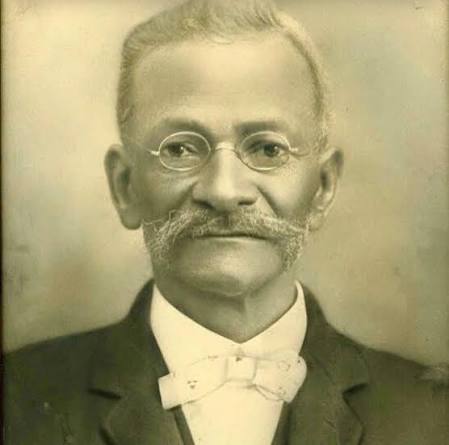
A white politician offered Lewis Adams whatever he wanted for the Black vote, and Adams asked for a school. This was Alabama in 1880, when most men in his place took the cash and went home. He was a tinsmith who had been born a slave and taught himself to read, and he did not ask for a dime for himself.
That school is Tuskegee University.
A white man running for the Alabama legislature needed the Black vote, and he asked Lewis Adams what it would take to earn it.
This was 1880. The men who bargained for Black votes in those days usually wanted the deal settled in cash, or a favor, or a little something quiet for the household.
Adams asked for a school.
He did not ask for a dollar for himself. He asked the state of Alabama to pay for a school that would train Black teachers, so that Black children across Macon County could be taught by somebody who knew how.
That school is Tuskegee University.
You know the name. You have heard of Booker T. Washington, and probably of George Washington Carver, who taught there.
The tinsmith who made the whole thing happen, most folks never heard of him at all.
Lewis Adams was born into slavery in Tuskegee on October 27, 1842. The plantation belonged to a white livery-stable owner named Jessie Adams, who was also his father.
He grew up in the plantation’s work shops. By the time he was a grown man he had mastered three trades with his hands, tinsmithing, harness-making, and shoemaking.
Nobody taught him to read.
Alabama law in those years fined a person up to five hundred dollars for teaching a Black person to spell, read, or write. So he learned on the sly, looking over the shoulders of the white Adams children while a hired tutor gave them their lessons.
He came out of slavery in 1865 knowing three trades and several languages, and he opened his own shop in downtown Tuskegee, near where the public square stands now. The work was clean and the man was steady, and before long the whole town ran its business through his shop.
White customers and Black customers both. Young Black men came to learn a trade from him, the way apprentices always have.
Years later, Booker T. Washington tried to explain where a self-taught former slave got a mind like that.
He wrote that Adams derived his “unusual power of mind from the training given his hands in the process of mastering well three trades during the days of slavery.”
The hands came first. Everything else was built on top of them.
By 1880, Adams was the man Black Tuskegee listened to, a deacon and the Sunday-school superintendent at Butler Chapel A.M.E. Zion Church. When the white candidates came hunting the Black vote, they came to him, because he was the one who could deliver it.
He had already watched his own church try to run a little school for Black children and fail, for lack of trained teachers to keep it standing.
So when they asked his price, he already knew it. He wanted teachers, which meant he wanted a school to make them.
Adams delivered the vote. The candidate won, and in 1881 the Alabama legislature set aside two thousand dollars a year for a normal school for Black students in Tuskegee.
Two thousand dollars, and not one thing more. No land, no building, no teacher, no desks.
Adams was named one of the school’s three commissioners. He and a white banker named George Campbell, himself a former slaveholder, wrote to Hampton Institute in Virginia and asked it to send a principal.
Hampton’s General Samuel Armstrong sent them a twenty-five-year-old former slave named Booker T. Washington.
Washington stepped off into a town where he knew no one, and Lewis Adams took him in. Adams’s oldest daughter, Mary Ann, cooked the young principal his first meal in Tuskegee.
The school opened on the Fourth of July, 1881, in a run-down building beside Adams’s church, with about thirty students and the one teacher.
Adams did not stand back and let the young man carry it alone.
He bought a horse for the school, and a second-hand lumber wagon, and a plow, a harness, and feed. When the money ran short, and it ran short constantly, he was one of two men Washington leaned on.
Washington put it plainly in his book. There were two men in Tuskegee, he wrote, “upon whom I have depended constantly for advice and guidance,” and from whom, he added, he had “never sought anything in vain.”
One of those two men had owned slaves. The other had been one, and that one was Adams.
When Washington sailed for Europe to raise money for the school, Adams went along and translated his French, his German, and his Italian.
The first class finished, and the first diploma Tuskegee ever handed out passed from Booker T. Washington’s hand into the hand of a young woman named Virginia Adams.
Lewis Adams’s daughter. The tinsmith’s girl, holding the first thing the school her father built ever gave anybody.
Adams kept his seat on the board for the rest of his life.
He died on April 30, 1905, where you would have looked for him on a Sunday morning. He was in Sunday school at his own church, and a stroke took him while he was singing a hymn called “Whosoever Will Let Him Come.”
A man who spent his whole life prying doors open for children the world wanted shut out, gone in the middle of a song about a door that stays open to anybody at all.
They buried him in Tuskegee. The stone over him says he was “Faithful in all the relations of life.”

