


The new #NigerianPassportFee regime needs immediate review. In this OpEd that roundly condemns it as illogical and an economic aberration, equally contains some modest recommendations. Here’s a snapshot…
Nigeria does not need to squeeze citizens to fix its passport system. There are smarter, fairer approaches:
- Benchmark fees to income. It should be possible to cap costs at 10–15% of minimum wage. Compared to the minimum wage, a Nigerian passport should not cost more than ₦10,500
- Introduce tiered pricing by lowering standard fees with modest surcharges for expedited processing.
- Subsidise vulnerable groups. Students, job seekers, and some retirees have less disposable income and should pay less.
- Leverage technology, not citizens’ pockets. Evidence abounds that digitisation can reduce operating costs.
- Tie fees to service guarantees. A slightly higher cost, which should be optional, must mean faster, transparent, and trackable delivery.

Sep 02, 2025 • by Collins Nweke • Source: Collins Nweke •  187 views
As of September 1, 2025, Nigerians seeking international passports will pay ₦100,000 for a 32-page booklet and ₦200,000 for a 64-page booklet with a 10-year validity. At a time when the national minimum wage stands at ₦70,000, this single policy decision pushes Nigeria into global infamy: the country now has the highest relative passport cost in the world.
This is not just a misguided policy; it is an economic aberration and a direct assault on the aspirations of millions of Nigerians. Yet, the managers of the nation’s affairs have chosen for Nigeria to make another world history for the wrong reasons.
A Passport Should Be a Right, Not a Luxury
Passports are not luxury items. They serve as gateways to education, business, family reunification, and economic opportunities. In a globalised economy, the ability to move freely is increasingly tied to upward mobility. Yet, under the new regime, obtaining a passport in Nigeria now costs 143% of a worker’s monthly minimum wage.
To put this into a global context, here is a comparative snapshot of passport fees as a proportion of minimum wage or standard pay:
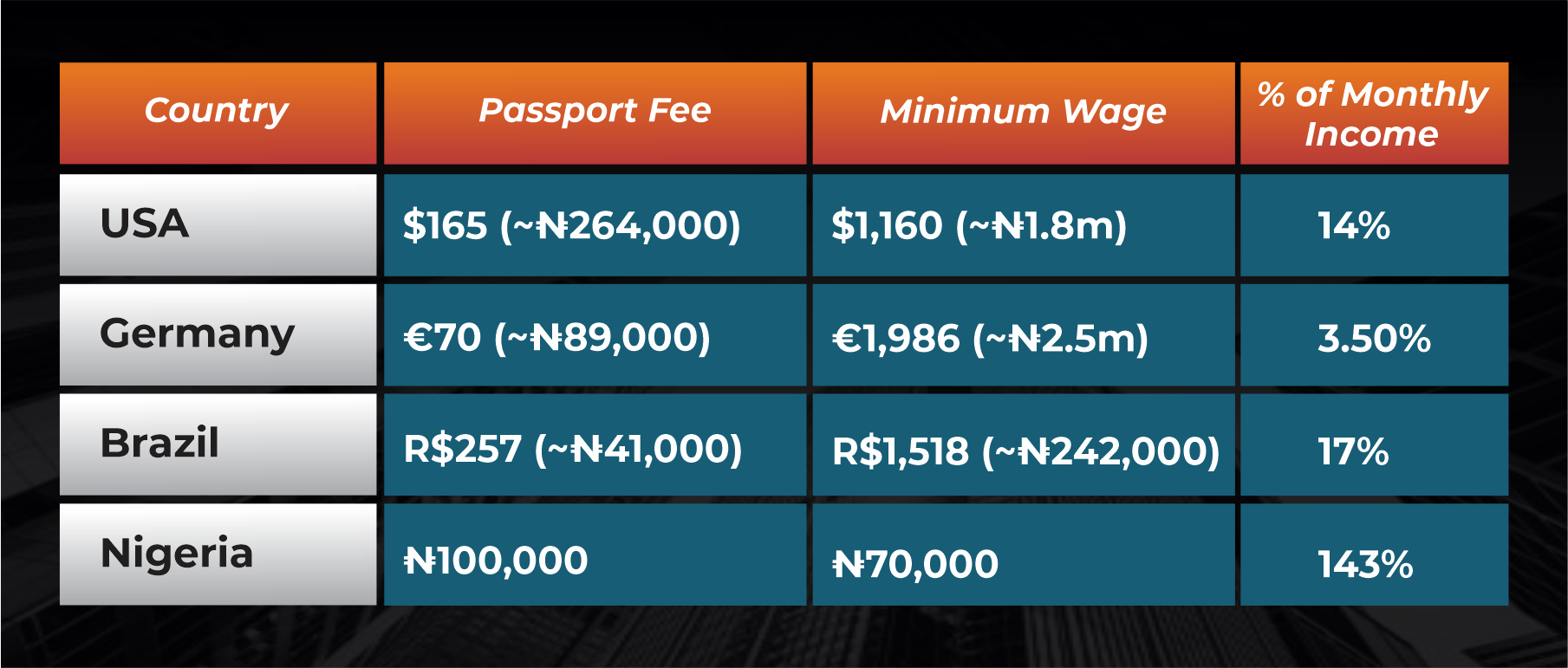
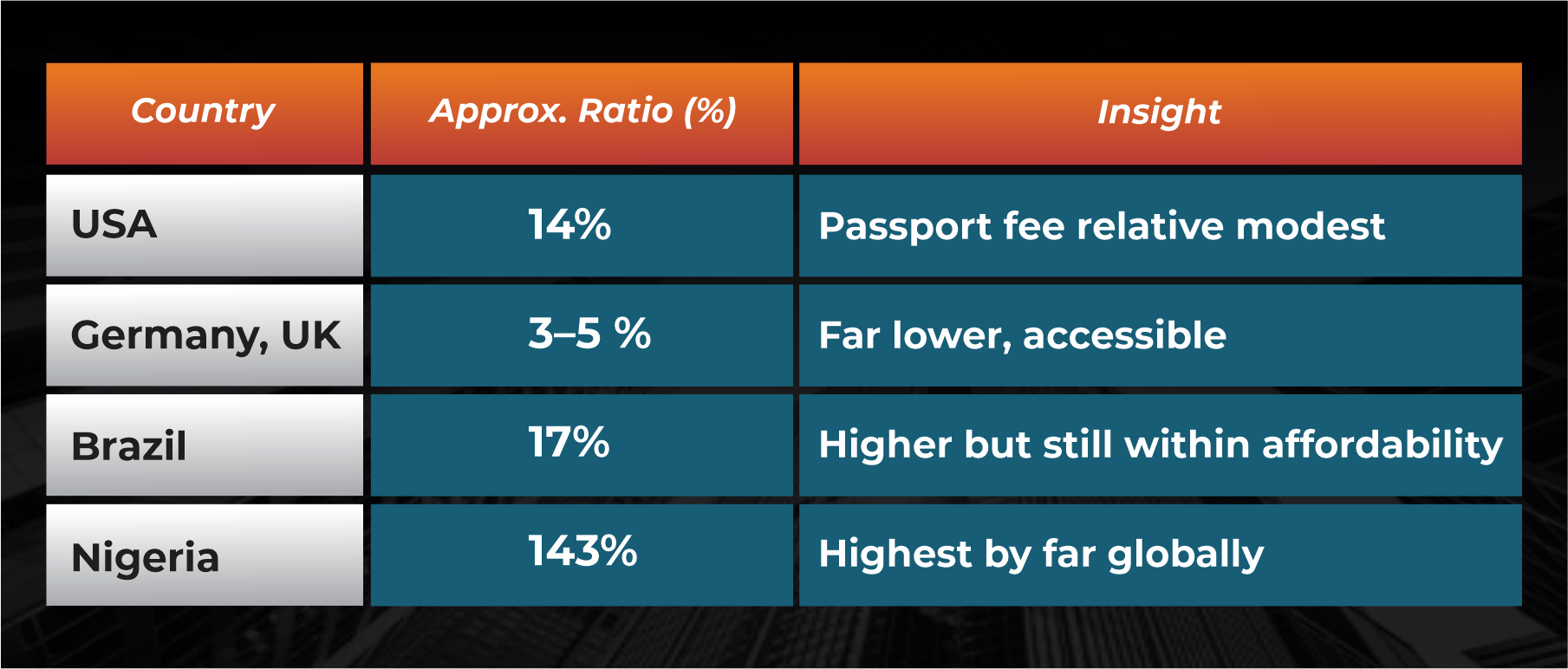
Passport Fee Comparison in Global Context
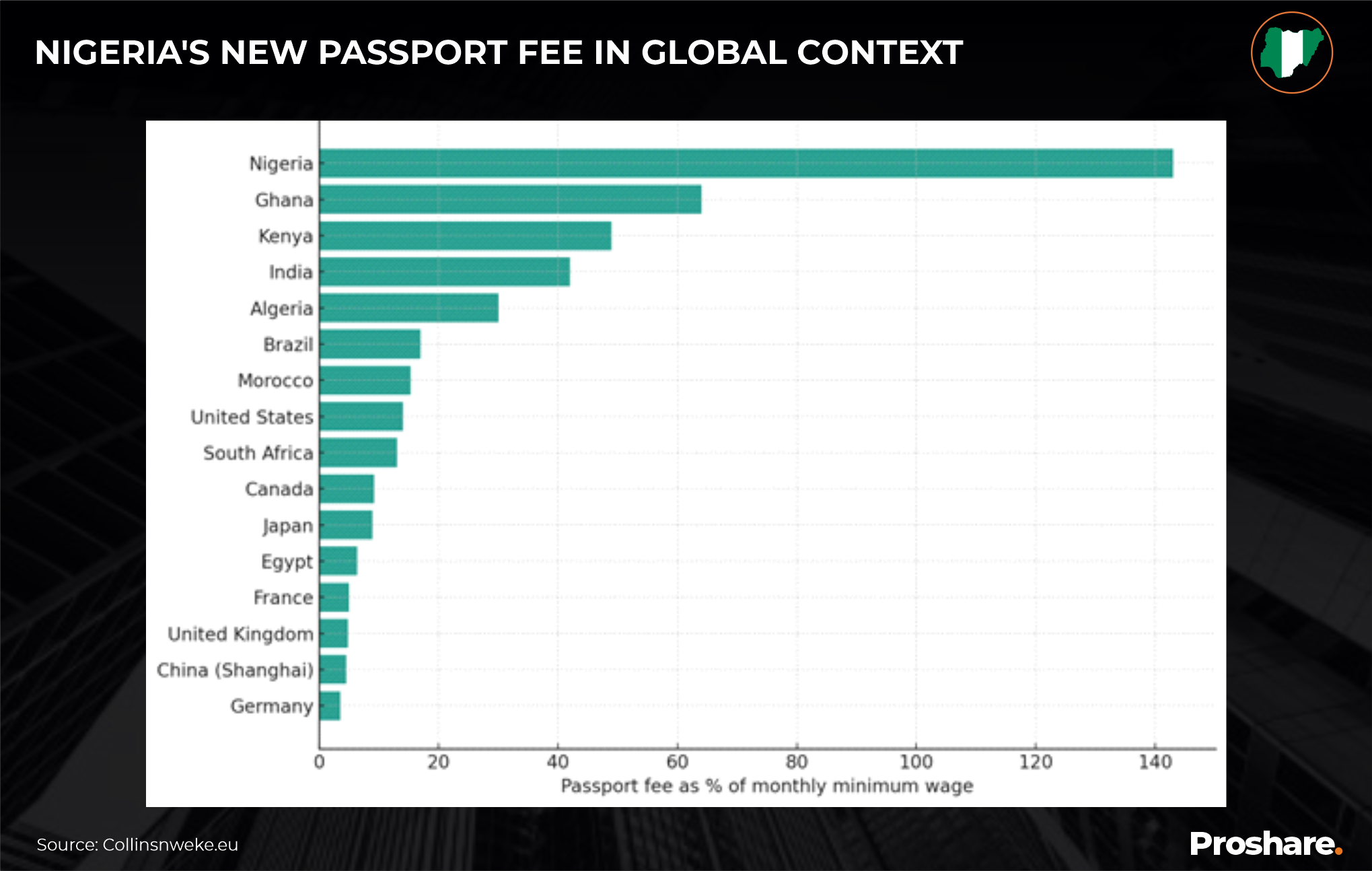
Chart Credit: collinsnweke.eu
A Shortsighted and Regressive Policy
The government has defended the hike as a revenue-boosting reform aimed at improving passport processing, curbing corruption, and modernising infrastructure. But these arguments crumble under scrutiny.
For millions of low- and middle-income Nigerians, this policy prices them out of opportunities. The wealthy and politically connected will pay without blinking; the rest are excluded from the very system that should empower them.
Diaspora Impact: Shooting Ourselves in the Foot
The Nigerian diaspora remitted US$23bn in 2023, making them one of the country’s most significant sources of foreign exchange. Yet, by making passports unaffordable, the government risks slowing migration pipelines, business travel, and talent mobility. These are all vital drivers of remittance flows.
This is an act of economic self-sabotage. A nation that cannot facilitate its citizens’ access to global opportunities undermines its own growth trajectory.
Considering Reasonable Alternatives
Nigeria does not need to squeeze citizens to fix its passport system. There are smarter, fairer approaches:
- Benchmark fees to income. It should be possible to cap costs at 10–15% of minimum wage. Compared to the minimum wage, a Nigerian passport should not cost more than ₦10,500
- Introduce tiered pricing by lowering standard fees with modest surcharges for expedited processing.
- Subsidise vulnerable groups. Students, job seekers, and retirees have less disposable income and should pay less.
- Leverage technology, not citizens’ pockets. Evidence abounds that digitisation can reduce operating costs.
- Tie fees to service guarantees. A slightly higher cost, which should be optional, must mean faster, transparent, and trackable delivery.
Closing Thoughts-Needed: A Public Policy Rethink
Leadership is about choices. This choice is the wrong one. A passport is a gateway to possibility, not a privilege for the wealthy. By setting its fees at the highest relative rate globally, Nigeria signals a troubling disregard for fairness, inclusion, and human capital.
The government must urgently reverse course and adopt a fee regime that aligns with economic realities, international norms, and Nigeria’s development priorities because no nation can prosper by locking its people behind economic borders.
About the Author
The author, Collins Nweke is an International Trade Consultant & Economic Diplomacy researcher. He was a former Green Councillor at Ostend City Council, Belgium, where he served three consecutive terms until December 2024. He is a Fellow of both the Chartered Institute of Public Management of Nigeria and the Institute of Management Consultants. He is also a Distinguished Fellow of the International Association of Research Scholars and Administrators, serving on its Governing Council. He writes from Brussels, Belgium. X: @collinsnweke E: admin@collinsnweke.eu W: www.collinsnweke.eu

