


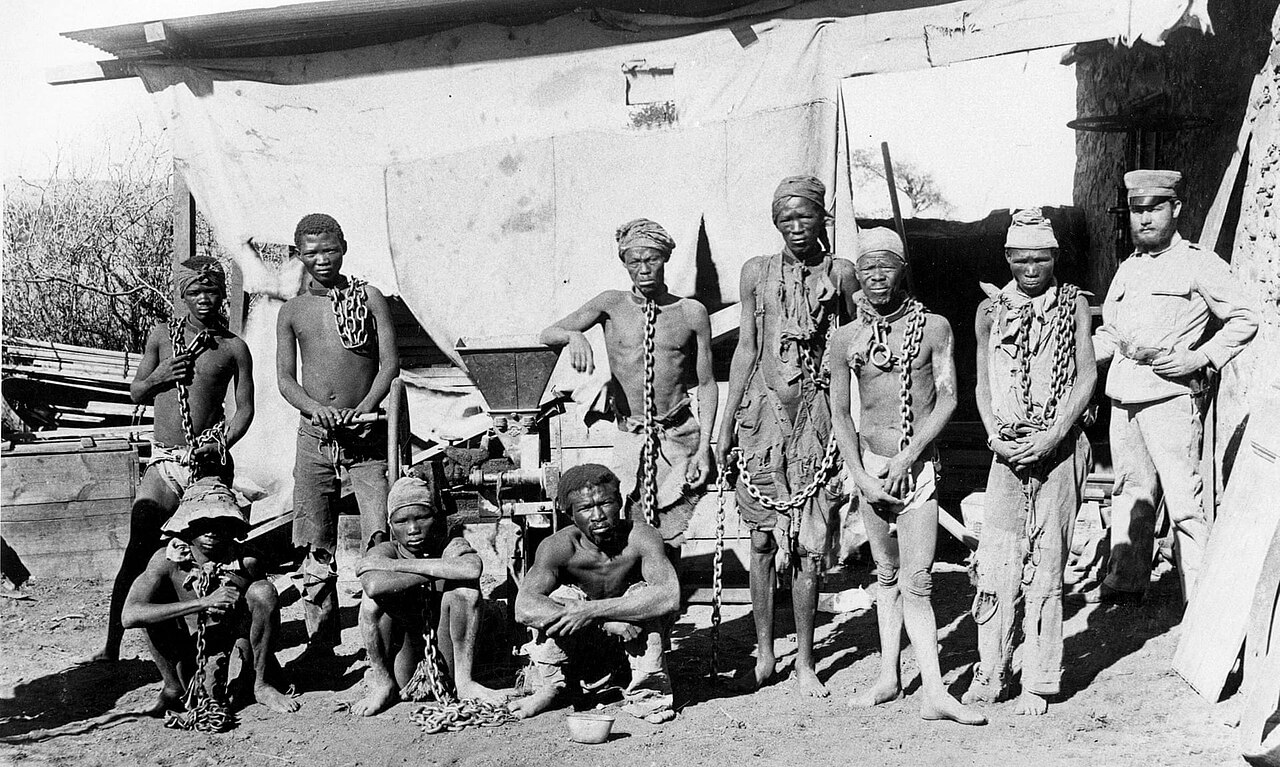
When one looks at the members of the European Union’s lackadaisical and almost nonchalant response to the proposal presented by Ghana in the UN, concerning the Trans Atlantic slave crime which was designated as “the gravest crime against humanity’ one is forced to be reminded of the many many other atrocities of the colonising Europeans against many African hations and peoples.
The is the story of the massacre of the Herore and Nama peoples by the German colonizers
The Herero and Nama genocide, or the Namibian genocide, was the extermination of the Herero and the Nama people in German South West Africa (now Namibia) perpetrated by the German Empire between 1904 and 1908. Around 40,000 to 80,000 Hereros (80 percent of their pre-war population) and 10,000 Nama (half of their pre-war population) were killed.
Facing the consolidation of German rule and attempts to subjugate Africans into a subordinate labor reserve, Herero chief Samuel Maharero launched a surprise uprising on 12 January 1904. Initially, the Herero uprising was a success, although colonists were enraged at being defeated by a people they considered inferior. After reinforcements arrived from Germany, the Herero were surrounded and routed at the Battle of Waterberg in August.
During the following months, they fled into the Omaheke Desert where a majority died from thirst, starvation, or small-scale German massacres. German commander Lothar von Trotha ordered the execution of all Herero men, but in practice, the women and children were also killed. After December 1904, German policy was to incarcerate all Herero people in concentration camps, where around half died due to lack of shelter and food, combined with slave labor. A number of racist laws were also passed.
The Nama initially fought alongside the Germans, including at Waterberg. However, they revolted against the Germans in September 1904, which lasted until 1908. German soldiers proceeded to round up any Nama they could find, and Trotha issued a second extermination order, this time against them, on 22 April 1905.
In 2015, Germany acknowledged that a genocide had been committed. Later negotiations with the Namibian government led to a controversial deal in 2021, according to which Germany would pay out 1.1 billion euros (US$1.3 billion) in the form of ex gratia development aid, while rejecting any legal responsibility for the genocide.

