


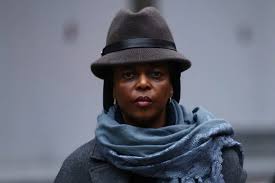
Like dressing and looking like a movie star
At the resumed hearing of the UK corruption trial involving former Nigerian Minister of Petroleum Resources, Diezani Alison-Madueke, prosecutors on Thursday presented what they described as a substantial body of documentary and digital evidence before Southwark Crown Court.
The prosecution told the court that materials placed on the record included transcripts of audio recordings, WhatsApp communications, emails, and correspondence allegedly recovered during searches conducted by the National Crime Agency and the Metropolitan Police at properties linked to the defendant.
During the proceedings, prosecutors outlined a number of allegations said to arise from the seized materials, emphasising that these matters form part of the prosecution’s case and remain subject to judicial determination.
Among the issues referred to in open court were claims attributed to oil executive Olatimbo Ayinde, suggesting that individuals associated with businessman Kola Aluko benefited from their proximity to him.
Ayinde is an ally of President Bola Tinubu.
The court also heard references to an alleged acrimonious dispute between Ms. Ayinde and businessman Femi Otedola, including a letter reportedly addressed to former Nigerian President Muhammadu Buhari in which concerns about threats to her safety were said to have been raised.
Prosecutors further alleged that a politician and businessman, Dumebi Kachikwu, acted as an intermediary in certain financial transactions connected to his brother, Ibe Kachikwu, a former Minister of State for Petroleum Resources and former Group Managing Director of the Nigerian National Petroleum Corporation.
The court heard claims of substantial monetary transfers, luxury expenditures, including the alleged purchase of a high-value watch from Harrods, and payments said to have covered medical expenses.
It was also stated that correspondence authored by lawyer and current Minister of Aviation and Aerospace Development, Festus Keyamo, in his capacity as legal counsel, characterised some of the payments as relating to land transactions.
Diezani Alison-Madueke Lavished Over N4Billion In London Luxury Store, Enjoyed Private Jets While In Office –UK Prosecutor
In addition, the prosecution referred to materials said to contain telephone communications involving Nigeria’s current President, Bola Tinubu, and former Vice President, Yemi Osinbajo, as well as records of meetings involving Osinbajo’s former chief of staff, Adeola Ipaye, parts of which were reportedly transcribed.
Prosecutors emphasised that all materials cited were being tendered as part of the prosecution’s evidentiary case in support of the charges before the court.
The trial continues, with the defence expected to respond as the proceedings advance.
Alison-Madueke, a former President of the Organisation of Petroleum Exporting Countries (OPEC), is currently standing trial at Southwark Crown Court on five counts of accepting bribes and an additional count of conspiracy to commit bribery.
She has pleaded not guilty to all charges, including conspiracy to commit bribery.
Previously, jurors were told that the former minister lived an extravagant lifestyle in the UK, including using a personal shopper at Harrods, a service reserved for Black Tier Rewards members who spend more than £10,000 annually.
According to reports, prosecutors further alleged that more than £2 million was spent on Alison-Madueke’s behalf at the Brompton Road store, with several purchases made using payment cards linked to Nigerian oil magnate Kolawole Aluko and the debit card of his company, Tenka Limited.
UK Court Hears Allegation That Nigerian Ex-Petroleum Minister Diezani Took £100,000 Bribe
The court was also told that about £4.6m was spent refurbishing properties in London and Buckinghamshire allegedly linked to her use.
Aluko, a petroleum and aviation magnate named in the Panama Papers, was previously investigated over allegations that he helped move millions of dollars out of Nigeria as kickbacks to Alison-Madueke. Prosecutors said he also held contracts with state-owned oil entities while seeking new ones.
The former minister was filmed leaving the court on Thursday without the use of a walking stick, accompanied by her driver or bodyguard as they made their way to a waiting BMW.
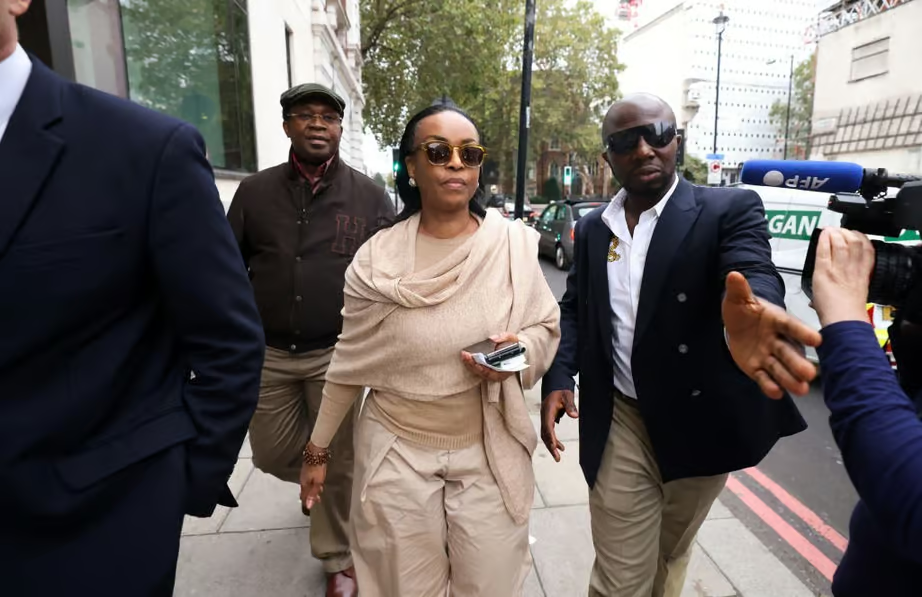
Alison-Madueke was also captured on video departing Southwark Crown Court in London on Wednesday, walking briskly and unaided, in contrast to earlier court appearances in which she had been seen using a walking stick.
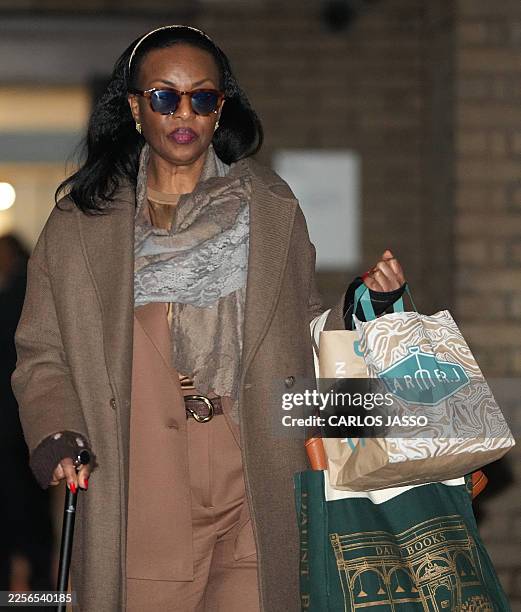
On Monday and Tuesday, Alison-Madueke was observed arriving at and leaving the court with a walking stick.
SaharaReporters had questioned the use of the aid, noting that it was unclear whether it was medically necessary or merely a support prop, as no official clarification was provided in court.
The exclusive video, obtained by SaharaReporters, shows Alison-Madueke, 65, accompanied by a bodyguard or driver who carried her bag to a waiting BMW.
On Tuesday, prosecutors told Southwark Crown Court that the former Nigerian Petroleum Minister accepted £100,000 in cash while in office, in addition to lavish benefits.
Prosecutor Alexandra Healy said Alison-Madueke received cash, private jet flights, chauffeur-driven cars, and luxury goods from Louis Vuitton and Harrods from industry figures seeking oil and gas contracts in Nigeria.
Nigeria: Everything you need to know about Diezani Alison-Madueke’s corruption trial
As prosecutors detail a decade of ‘pay-to-play’ contracts traded for private jets and Harrods sprees, Nigeria’s former petroleum minister finally faces a UK jury.
Diezani Alison-Madueke – Nigeria’s former petroleum minister and a former OPEC president – is being tried at Southwark Crown Court in London on six counts linked to alleged “financial or other advantages” received between 2011 and 2015 in return for helping steer oil-and-gas contracts.
She denies wrongdoing. The trial is expected to run about 10-12 weeks.
What is she charged with?
The headline charges are “accepting bribes” (five counts) and “conspiracy to commit bribery” (one count).
READ MORE South Africa’s Gupta siblings, Nigeria’s Diezani…Africans wanted for corruption charges
Prosecutors must persuade a jury that she requested/accepted advantages and that these were connected to improper performance of her role as minister – i.e., that the benefits were not innocent gifts but part of a corrupt exchange for influence over contract awards.
What advantages does the prosecution say she received?
Across the counts, the alleged benefits include:
- At least $137,000 in cash
- Use of, refurbishment work on, and staff costs for several London properties
- Furniture
- Chauffeur-driven cars
- Private jet flights (including a flight to Nigeria)
- School fees for her son
- Luxury goods (including spending at retailers such as Harrods and Louis Vuitton)
Who allegedly provided the bribes?
The indictment and reporting describe the alleged advantages as coming from people linked to two Nigerian energy groups: Atlantic Energy Drilling Concept Nigeria Limited (Atlantic Energy) and SPOG Petrochemicals.
The prosecution case is essentially ‘pay-to-play’: benefits in London and elsewhere in exchange for influence over Nigerian oil-and-gas contract awards in the 2011-2015 window.
P&ID vs Nigeria: A state affair with high stakes for the whole country
Who are the other defendants in the London dock?
Two others are being prosecuted on related bribery charges in the same case: Alison-Madueke’s brother Doye Agama, who is the former archbishop of the Apostolic Pastoral Congress, and Olatimbo Ayinde, CEO and co-founder of Dutchford Exploration and Production.
How does this connect to bribery cases in the US involving the former petroleum minister?
US civil forfeiture actions have described a bribery scheme in which two Nigerian businessmen – Kolawole Akanni Aluko and Olajide Omokore – allegedly paid bribes to Alison-Madueke (and others) to help secure oil contracts, then laundered the proceeds into luxury assets.
This matters for London because the UK trial is, in effect, the criminal courtroom counterpart to a decade of asset tracing: the narrative spine (contracts, proceeds, luxury benefits/property) is shared even when the legal theories and defendants differ by jurisdiction.
What contracts did it involve?
Public reporting on the UK case does not reveal which specific contracts (precise blocks, allocations, swap lines) the jury will be shown.
The allegation is that she used ministerial influence over ‘multi-million-pound’ oil-and-gas contracts.
Nigeria’s EFCC boss suspended from office following secret tribunal
In the broader context, Atlantic Energy has been associated in Nigerian reporting with NNPC/NPDC-era strategic alliance structures and crude-lifting economics during that period – arrangements that can generate large discretionary rents and lend themselves to influence trading.
Treat this as contextual background rather than a definitive description of what the UK jury will see.
Why is this being tried in the UK at all?
Because the alleged benefits and conduct have substantial UK touchpoints – notably London properties, services and spending – the UK can assert jurisdiction under its bribery framework.
In practice, the UK can compel local witnesses (estate agents, service providers), obtain domestic financial records, and use UK freezing powers over assets.
Is Diezani Alison-Madueke in custody?
No. She has been on bail for years. She was first arrested in London in October 2015, later formally charged by the UK’s National Crime Agency in August 2023, and remained on bail pending trial.
What evidence is likely to be decisive?
Based on how transnational bribery cases are usually built, expect:
- Property evidence – leases, beneficial use, renovation invoices, staff payrolls
- Travel and luxury procurement – private jet manifests/charters, chauffeur logs, high-end retail purchases
- Money flows – bank transfers, cash movement narratives, intermediaries’ accounts
- Witness testimony – especially from service providers and any insiders who can connect benefits to contract asks
- Communications – messages/emails tying timing of benefits to contract decisions
Even without a ‘smoking gun’, prosecutors often build these cases through timelines: benefit arrives, contract decision moves, intermediaries coordinate.
What does she risk if she is convicted?
Conviction exposure under UK bribery law can include custody and substantial financial penalties, alongside confiscation proceedings.
READ MORE Nigeria’s EFCC investigates Aisha Achimugu for $150m fraud
Separately, UK investigators have previously indicated that assets worth millions of pounds linked to the alleged offences were frozen.
How does this affect US asset recovery?
US authorities have said they recovered $53.1m in assets linked to alleged corruption involving the former minister, including luxury real estate in California and New York and the super-yacht Galactica Star.
The US and Nigeria later announced an agreement to repatriate $52.88m of such forfeited assets, with allocations including rural electrification.
What is happening on the Nigerian side?
Nigeria’s Economic and Financial Crimes Commission (EFCC) has pursued money-laundering charges and extensive asset forfeiture.
The agency has publicly said it recovered about $153m and secured final forfeiture of more than 80 properties linked to the broader case universe.
READ MORE Erastus Akingbola: Nigeria’s longest running corruption case
After her UK arraignment in 2023, the EFCC said it obtained an arrest warrant for Alison-Madueke and initiated extradition proceedings for her to face Nigerian charges (separate from the UK indictment).
There is also ongoing litigation in Nigeria around forfeitures and auctions of seized assets, which keeps the file politically alive and administratively contentious.
What is the larger significance of the trial?
This is a test case for three things at once:
- Transnational enforcement – whether a foreign court can successfully prosecute alleged grand corruption rooted in another state’s resource sector.
- The London value chain – how high-end property, luxury retail and professional services can become the consumption layer of political rents.
- Nigeria’s accountability gap – if the UK secures a conviction (or at least a clean, evidence-rich trial) while Nigeria’s criminal process remains bogged down, it sharpens the domestic argument that elite impunity is hardest to break at home – and easiest to puncture abroad.
What should you watch for as the trial unfolds?
- Whether prosecutors name the contract vehicles explicitly (blocks, allocations, counterparties) or keep it at the “contract access” level
- The court’s approach to contextual evidence (how much of the wider Diezani-era scandal history the jury hears)
- Any evidence that turns lifestyle support into an explicit bargain (timed asks, intermediaries’ notes)
- Whether restraint/freezing orders expand, and how that interacts with asset return narratives in Abuja and Washington DC.

