


Many of those who tuned in to US President Donald Trump’s news conference on Saturday were probably hoping to hear dramatic details of how US forces seized Venezuela’s leader, Nicolás Maduro, in a pre-dawn raid.
But arguably a more surprising moment came when Trump announced that now that Maduro was in custody, the US would “run” Venezuela “until such time as we can do a safe, proper and judicious transition”.
In another unexpected development, he added that Secretary of State Marco Rubio had been speaking to Maduro’s Vice-President, Delcy Rodríguez, who he said was “essentially willing to do what we think is necessary to make Venezuela great again”.
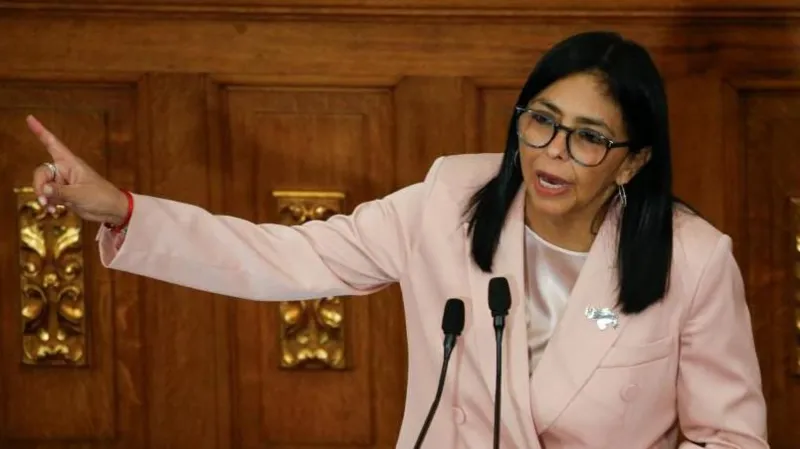
However, Rodríguez seemed less than co-operative in her own news conference later where she denounced Maduro’s detention as a kidnapping and stressed that Venezuela would not become a colony.
Given these conflicting messages, many are asking who is now in charge in Venezuela.
Under Venezuela constitution, it falls to the vice-president to take over should the president be absent.
So, on the face of it, the Venezuelan Supreme Court ruling that Delcy Rodríguez was the country’s acting president seems like a logical step.
But most Venezuela watchers had expected the immediate aftermath of a US intervention to look differently.
The US – and many other nations – did not recognise Nicolás Maduro as Venezuela’s legitimate president, having denounced the 2024 election as rigged.
Maduro was declared president by Venezuela’s electoral council (CNE), a body dominated by government loyalists.
But the CNE never produced the detailed voting tallies to back up their claim and copies of voting tallies collected by the opposition and reviewed by the Carter Center suggested that the opposition candidate, Edmundo González, had won by a landslide.
This is great
©️The Scope news

