


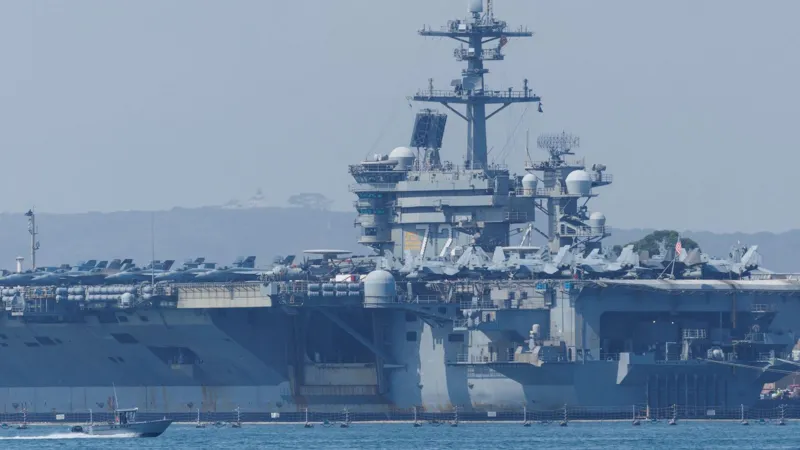
The arrival of the USS Abraham Lincoln carrier strike group into the US Central Command area of responsibility, close to Iranian waters, has sharpened the sense that a broader confrontation may be taking shape.
Coming amid the most extensive and violent crackdown on protests in Iran in recent memory, the deployment underscores how close Washington and Tehran may now be to a direct showdown, closer than at any point in recent years.
Iranian leaders find themselves squeezed between a protest movement increasingly demanding the removal of the regime itself and a US president who has kept his intentions deliberately opaque, fuelling anxiety not only in Tehran but across an already volatile region.
Iran’s response to a potential US military strike may not follow the familiar, carefully calibrated pattern seen in earlier confrontations with Washington.
President Donald Trump’s recent threats, made in the context of Iran’s violent suppression of domestic unrest, come at a moment of exceptional internal strain for the Islamic Republic. As a result, any US attack now carries a significantly higher risk of rapid escalation, both regionally and inside Iran.
In recent years, Tehran has shown a preference for delayed and limited retaliation.
After US strikes on Iranian nuclear facilities on 21-22 June 2025, Iran responded with a missile attack on the US-operated Al Udeid Air Base in Qatar the following day.
According to President Trump, Iran had given advance warning of the strike, allowing air defences to intercept most of the missiles. No casualties were reported. The exchange was widely interpreted as a deliberate attempt by Iran to signal resolve while avoiding a wider war.
A similar pattern emerged in January 2020, during Trump’s first presidency. Following the US assassination of Quds Force commander, Qassem Soleimani near Baghdad airport on 3 January, Iran retaliated five days later by firing missiles at the US Ain al-Asad airbase in Iraq.
Again, advance warning was provided. While no US personnel were killed, dozens later reported traumatic brain injuries. The episode reinforced the perception that Tehran sought to manage escalation rather than provoke it.
will this war ever end
©️The scope news

